| |
| Tuesday, 10 November 2026 |
| The Roots of Jazz |
| Emma Johnson |
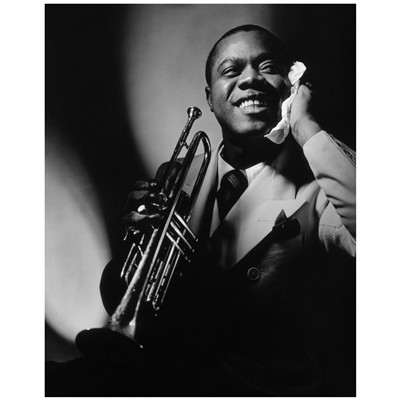 |
In this talk, Emma, an internationally acclaimed clarinettist, will look at the part African Blues and Cakewalk, American Classical and Vaudeville, Latin American Dance, and Middle Eastern Klezmer all played in the story of jazz. New Orleans at the end of the 19th century was a busy port welcoming ships and sailors from all over the world bringing with them many diverse styles of music. It was also one of the few places in America where the music of the slave population was not just tolerated but openly enjoyed by black and white communities alike. In this Creole crucible it was not long before such a kaleidoscope of musical traditions would come together, react and evolve into an exciting new music which would revolutionise and democratise culture, namely jazz. Jazz's evolution didn't happen overnight of course and along the way we will enjoy some of the greatest musical artists of the twentieth century: Louis Armstrong, Benny Goodman, Artie Shaw, Ella Fitzgerald and Duke Ellington to name but a few. Lecturer's Biography: With 30 CDs to her name, Emma Johnson is one of the few clarinettists to have performed as a soloist all over the world. She also enjoys giving talks about music - Woodwind Wizardry and The Poet John Miltonwere both broadcast by BBC radio and she has lectured about composers Gerald Finzi and Malcolm Arnold for the internet company Tonebase, as well as about Schubert and Brahms for Martin Randall Travel. Johnson studied Music and English at Pembroke College, Cambridge University, where she was the first woman to be made an Honorary Fellow. She was honoured by the Queen with an M.B.E. in 1996. Her charity, the Emma Johnson Music Foundation, gives workshops in primary schools to introduce children to instrumental music. Image - Louis Armstrong |
|
| Tuesday, 08 December 2026 |
| Notre Dame de Paris - its Iconic Status in French History |
| Carole Petipher |
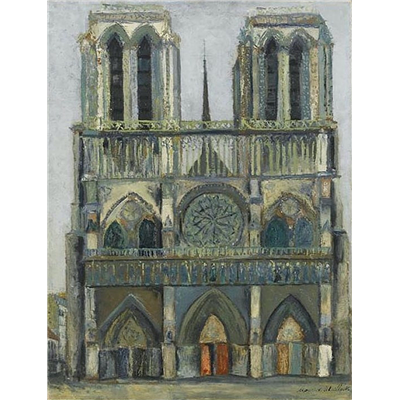 |
In December 2024, Notre Dame Cathedral in Paris, often referred to as the Soul of the City, reopened to the public after a devastating fire had threatened to destroy it 5 years earlier. There had never been any doubt as to whether to restore or not. However, a seemingly impossible target had been set by the French President to rebuild; huge sums of donated money and teams of expert restorers ensured the timescale was met. Such is the symbolic power of this cultural icon in the psyche of the French people and indeed people beyond. In this lecture Carole explores the cultural significance of Notre Dame through the ages and what makes it so special. Lecturer Biography: Carole is an experienced guide and lecturer on combined history and art tours in France with 20 years experience. Having lived and worked on a number of bespoke river vessels and converted barges there she has used them as a platform from which to research her lectures. She uses art in all its guises to explore the characters who shaped France and likes to delve behind the scenes to discover hidden truths. She also acts as a guide for a privately owned ancestral home in her native Chilterns. Image - Notre Dame by Maurice Utrillo (1909) |
|
| Tuesday, 12 January 2027 |
| Now You See It Now You Don’t - The Art Of Visual Deception |
| Bertie Pearce |
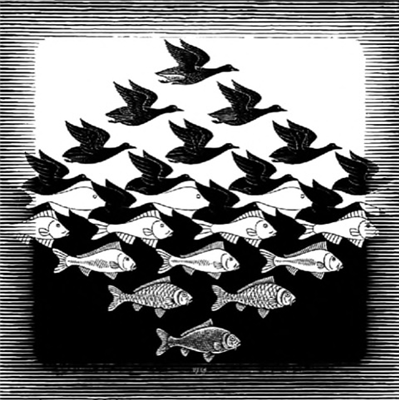 |
This is one of the quirkiest lectures you will ever hear. There is a universal delight in being deceived and in this lecture Bertie Pearce takes his audience on a whistle stop tour of art which fools, surprises and amuses the viewer. Beginning and ending with the Belgian surrealist, René Magritte, it encompasses Trompe L’eoil, Banksy, Bridget Riley, Arcimboldo and Escher to name a few. Hold on to your seats and get ready to be visually fried. Lecturer Biography: Has a BA (Hons) in Drama from Manchester University, and a Diploma Internationale from the École Internationale du Théatre, Jacques Lecoq. A member of the Inner Magic Circle, with Gold Star. Past experience includes lecturing and performing on cruise ships, and to U3A, historical societies, festivals, schools and colleges. In addition, has toured the world with a magic cabaret show and a one man show entitled All Aboard. Has written articles for newspapers and magazines on entertainment and theatre. Image - Woodcut print by M C Escher Sky and Water I (1938), public domain |
|
| Tuesday, 09 February 2027 |
| All the World’s a Stage: From Ancient Greece to the National Theatre. 2500 Years of Theatre in An Hour |
| Simon Whitehouse |
 |
Journey from the sun-drenched amphitheatres of ancient Athens to today's stages in this visually spectacular exploration of theatre's extraordinary evolution.
Discover how a religious festival became the foundation of Western drama, witness Roman
spectacle, and trace drama's medieval rebirth. Experience Shakespeare's golden age, explore Restoration comedy's wit and scandal with its first actresses, and meet revolutionary performers like Garrick and Siddons who redefined acting.
This richly illustrated lecture brings each era vividly to life through stunning imagery: ancient
theatres, Renaissance portraits, Hogarth's satirical paintings, Victorian theatrical art, and
photographs of legendary performances.
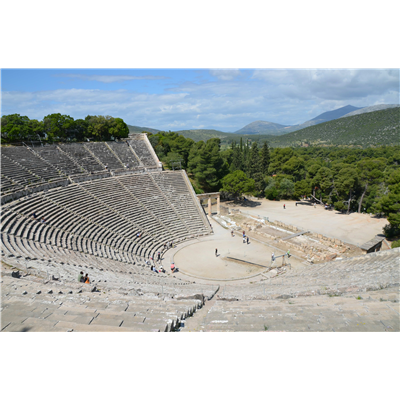
From Greek tragedy to absurdist drama, from masked choruses to Method acting—discover how theatre continuously reinvented itself while maintaining its essential power: the live communion between performer and audience. Lecturer Biography: Simon is a (recovering) actor, lecturer, presenter, Alexander Technique and voice teacher and award winning London Blue Badge guide. He has worked as a guide lecturer in house at Shakespeare’s Globe, the Royal Opera House, the BBC and the National Gallery guiding both public and private tours. He is on the faculty of Ithaca College and also lectures for the Blue Badge Guide training course on the performing arts and English literature. Simon’s specialisms and passions are theatre, literature, fashion and art history but whatever the subject, Simon will weave a wonderful story from it. Image - Ancient Theatre of Epidaurus in the Peloponnese - attribution Carole Raddato (Frankfurt, Germany) CC BY-SA 2.0 |
|
| Tuesday, 09 March 2027 |
| Ludwig van Beethoven on the 200th Anniversary of his Death (March 1827) - Classical Music’s Greatest Revolutionary |
| Sandy Burnett |
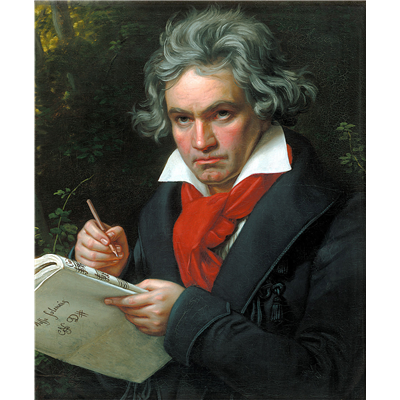 |
The 200th anniversary of Ludwig van Beethoven's death in March 1827 makes it a great time to reassess the legacy of this great composer. Born into a family of court musicians in Bonn, Beethoven became one of the greatest and most disruptive figures in the history of classical music; by the time he died in Vienna he had completely transformed music's cultural landscape. This lecture reflects on this brilliant, cantankerous, visionary and astonishingly original composer, and traces how he grew from Classical beginnings to become a true Romantic artist, or as he preferred to describe himself, a “poet in sound.” Lecturer Biography: Sandy is one of the UK’s most versatile music commentators, enjoying a career that combines broadcasting, performing and lecturing. After studying at St Catharine’s College, Cambridge and working as music director for the RSC, National Theatre and in London’s West End, Sandy Burnett spent a decade as one of the core team of presenters on BBC Radio 3. Combining engaging scholarship with hands-on expertise, he devises and leads cultural holidays all over the world and was appointed the Academy of Ancient Music’s Hogwood Fellow for the 2018-19 season. He has directed a complete performing cycle of Bach’s sacred cantatas, conducts the Chiswick Chamber Orchestra and is a first-call double bass player on the London jazz scene. Since 2013 he has devised and led cultural holidays all over the world, taking music lovers to venues as diverse as the opulent Leipzig Opera House and the intimate jazz clubs of New Orleans. He runs an online classical music appreciation Listening Club, and is the author of the Idler Guide to Classical Music. Image - Beethoven with the Manuscript of the Missa Solemnis (1820) by J K Stieler, , Beethoven-Haus in Bonn |
|
| Tuesday, 13 April 2027 |
| Hackfall - A Landscape back from the Brink |
| David Winpenny |
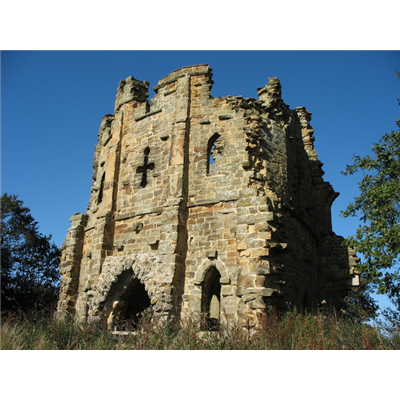 |
One of the great lost landscapes of England, Hackfall (now listed Grade I) was praised by William Gilpin, recommended by Wordsworth, painted by Turner – and Catherine the Great had views of it on her Wedgwood dinner service. This very early Romantic landscape was laid out in a deep, wooded gorge of the River Nidd, a few miles from Ripon in North Yorkshire, by the Aislabie family, whose nearby Studley Royal estate is now a World Heritage Site. Hackfall was just as renowned until the 1930s, when the family sold the estate. It slumbered and decayed for more 50 years until the last Secretary of State for War mobilised his friends and contacts to rescue it. Over the last quarter century this remarkable landscape of trees and water, dotted with follies and with a mysterious beauty, has been awoken with the help of the Woodland Trust, the Landmark Trust and its own Hackfall Trust. In 2011 its restoration won a Europa Nostra Grand Prix. This talk sets Hackfall in its historical context, examines how different generations viewed it, catalogues its decline and outlines the efforts to restore it to glory. Lecturer Biography: Studied English at Birmingham University and taught for several years before joining the Countryside Commission as Co-ordinator of its National Parks Campaign. Worked for the Central Office of Information in Leeds before setting up own public relations company. Author of 'Up to a Point - in search of pyramids in Britain and Ireland' and has written and contributed to several books for the AA. Has written for BBC Countryfile Magazine and English Heritage magazine. He is co-chairman of Ripon Civic Society and lectures on architectural and related subjects on cruise ships and on dry land. Image - Mowbray Castle, Hackfall attribution Paul Brooker - CC BY-SA 2.0 |
|
| Tuesday, 11 May 2027 |
| Mucha and the Slav Epic |
| Kathy McLauchlan |
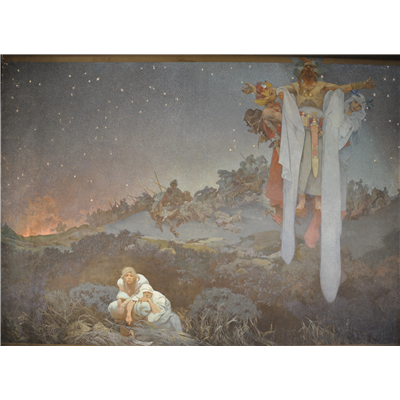 |
We are all familiar with Alfons Mucha as an icon of fin-de-siècle Paris, the poster designer who made actress Sarah Bernhardt immortal, and who turned advertising into an art form. Less well known is the work to which Mucha devoted over twenty years of his later career, and which he himself regarded as his greatest accomplishment. This was the Slav Epic, a series of 20 enormous canvases first shown in 1928, which presented a visual history of the Slavs from their mythical past to a visionary future. Mucha conceived his work as a gift to Prague and the Czech people: "I wanted", he said, "to talk in my own way to the soul of the nation". Find out if he succeeded. Lecturer Biography: A lecturer specialising in 19th-century art history, I am currently a course director at the Victoria & Albert Museum, organising courses and study days on the history of art and design. I teach at several institutions, including Art Pursuits. I am a graduate of Oxford University and the Courtauld Institute, with a PhD on French 19th-century painters in Rome. I am available for both individual lectures and study days. In addition to the subjects on my page I can cover: • Sketch and Finish in 19th-century French Painting • Montmartre fin de siècle • Mucha and the Slav Epic • America and the Sublime Landscape Image - The Slavs in their Original Homeland (1912) by Alfons Mucha, Prague City Art Gallery |
|
| Tuesday, 08 June 2027 |
| A Guide to Street Art in the UK 1945-2000 |
| Raymond Warburton |
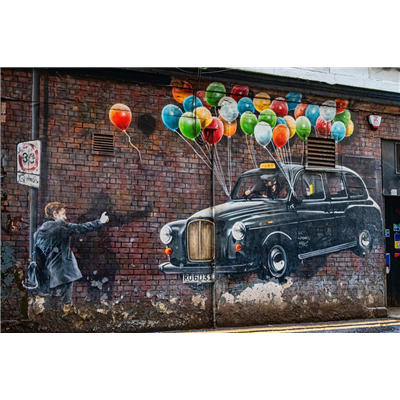 |
This lecture traces the growth of Street Art in the UK, since the early 1980s, when young British people went to New York and brought back stories of the explosion of graffiti, hip hop, and street dance in that city. Soon the streets of London, Bristol and other cities and towns were being sprayed and tagged with graffiti. The lecture will look at some of the pioneering street artists as well as the current generation. They include not only Banksy (who will get a strong mention) but also Inkie, Jody, DANK, STIK, My Dog Sighs, Artista, Annatomix, Rogue One, and Ben Eine. The lecture will talk about the rights and wrongs of graffiti, and include some of the lows and a few of the highs. Lecturer Biography: Ray has had a life-long love of art. However, in his twenties, Ray studied social sciences at the London School of Economics and the School of Oriental and African Studies. These studies led to a career in health and social care, with art being an evening and weekend passion. But all that changed in 2011, when Ray became a guide at Tate Britain and Tate Modern. Then from 2014 to 2017, he studied art history at the Open University, and then at the University of Buckingham, from where he gained an MA in the History of Art. And to cap it all, Ray became an Arts Society lecturer in 2017. Ray also knows what it’s like to be on the receiving end of lectures as he is a member of his local Arts Society in Blackheath. Image - Mural The World’s Most Economical Taxi painted by Rogue-One located on Mitchell Street, Glasgow attribution Art UK |
|
| Tuesday, 13 July 2027 |
| Culture, collection and controversy; whose art is it anyway? |
| Marie Conte Helm |
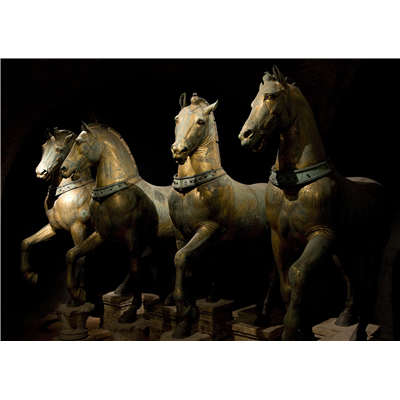 |
This lecture will consider the debates surrounding lost cultural treasures, from the ‘Elgin Marbles’ to the Buddhas of Bamiyan. It will address questions of rights of ownership, the case for the return of artefacts looted in the distant past, and the restoration of cultural sites damaged or destroyed during periods of conflict. Such issues are presenting challenges for museums, private collectors and national governments throughout the world who are seeking to balance the role of universal international art institutions with individual country’s interests in reclaiming or restoring their lost cultural heritage. Lecturer Biography: Professor Marie Conte-Helm is a long-established Arts Society Lecturer with a BA in History of Art and an MA in Asian Art and is a Fellow of the Royal Society of Arts. She was Director General of the Daiwa Anglo-Japanese Foundation from 1999-2011 and has held senior academic posts at various UK universities. She has most recently served as Executive Director of the UK-Japan 21st Century Group, and as a member of the Board of Governors of the University for the Creative Arts. She is widely published and has lectured throughout the UK and abroad. She is also an experienced cruise speaker and a Resident Historian with Viking Ocean Cruises, lecturing on many aspects of Asian Art and East-West Encounters. She was awarded an OBE in the 2011 Queen’s Birthday Honours for services to UK-Japan educational and cultural relations and the Order of the Rising Sun, Gold Rays with Rosette by the Government of Japan in 2019. Image - Horses of San Marco, looted by Republic of Venice in Sack of Constantinople (1204), public domain |
|
| Tuesday, 12 October 2027 |
| Art of North Africa; the Art, History and Culture of Morocco, Algeria, Tunisia and Libya |
| Christopher Bradley |
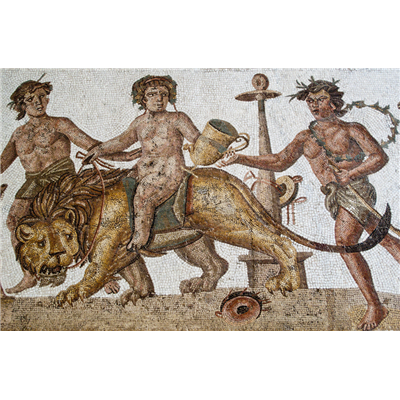 |
Ancient rock art from the Sahara and Berber tribal art in the Atlas Mountains are complimented by Greek and Phoenician maritime traders arriving into Carthage with Royal Purple dye. Roman Emperor Septimius Severus from Leptis Magna oversaw their best quality mosaics before the Arabs brought the faith of Islam. Mosques, mausoleums and private houses in Fez, Algiers, Kairouan and Tripoli often re-used Roman columns, lavishly enhanced with the stunning upside-down tilework technique known as Zellij - introduced into Andalucia - becoming azulejo tiles. All adorned with delicate arabesque decoration.
As Algeria - and even Libya – open their doors to visitors once again, now is the perfect time to examine the Art of North Africa. Lecturer Biography: Expert in the history and culture of the Middle East and North Africa. As a professional tour guide and lecturer he has led groups throughout the Middle East and Asia. He writes extensively on Arabia and is the author of the Insight Guide to the Silk Road and Berlitz Guides to Cairo; Abu Dhabi, Nile Cruising, Libya; the Red Sea; Oman and the Discovery Guide to Yemen. As a photographer he has pictures represented by several photographic libraries. As a film producer and cameraman he made documentaries for the BBC, National Geographic TV and Channel 4. Image - Roman mosaic depicting the god Dionysus (Bacchus) riding a lion, accompanied by a satyr, El Djem Archaeological Museum, Tunisia |
|
| Tuesday, 09 November 2027 |
| 1227-2027: Celebrating the 800th Anniversary of Medieval Salisbury |
| Sally Dormer |
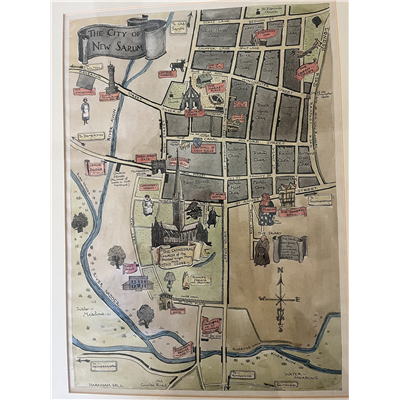 |
The Royal Charter issued by Henry III on 23 March 1227 recognised the recently founded New Sarum (modern Salisbury), as a city, with rights to host an annual fair and weekly Tuesday market. It also confirmed the cathedral’s relocation from Old Sarum, granted the Bishops of Salisbury significant powers, ecclesiastical and temporal, and helped secure funding for the magnificent Early English cathedral. Medieval Salisbury, arranged in a distinctive chequerboard plan and furnished with splendid monuments, flourished and became a prosperous new town. This lecture, commissioned to celebrate the 800th anniversary of the 1227 charter, will explore some of the surviving medieval monuments, set in their broader context. The cathedral will inevitably feature, alongside lesser known treasures including: books illuminated by the mid-13th century Sarum Master; the 14th-century Poultry Cross, sole survivor of the four market crosses originally in the Market Place; the 15th-century parish church of St Thomas (Becket), it’s spectacular painted Doom featuring an alewife heading to hell; the Hospital of St Nicholas, Harnham, for the poor, the sick and travellers, in existence by 1227; and Clarendon Palace, a little east of Salisbury, a hunting lodge transformed by Henry III into a palatial residence with tiled floors some of which live now in the British Museum. Lecturer Biography: Lecturer and tutor for the Early Medieval Year Course at V&A. Dean of 'European Studies' for 2 US Universities. Freelance lecturer for The Art Fund. Study tours, cruises and tour groups. BA (History) University of Durham; PhD (Medieval Manuscript illumination) and MA (Medieval History of Art) Courtauld Institute. Image - Plan of New Sarum by Pamela Carter by kind permission of her daughter (our lecturer) Sally Dormer |
|
| Tuesday, 14 December 2027 |
| Monopoly – a game we know so well, or do we? |
| Roger Mendham |
 |
Monopoly is one of the most successful board games of all time, but how well do we really know it? This talk covers the origin of the game and then focusses on the classic 1936 London board. How the properties were selected, the relationship between the members of each set and which ones don’t actually exist are just some of the questions addressed in this talk. Expect some surprises and great images as we look at the history of these familiar locations and uncover some of the mysteries behind Monopoly. Everyone will learn something new about this familiar old friend of a board game. Lecturer Biography: A keen and accomplished photographer Roger has gained Distinctions from the Royal Photographic Society and has recently completed 3 years as President of the Surrey Photographic Association. His artistic taste is predominantly 20th century and he is particularly interested in the visual aspects of art. He has studied the evolution of photography from its earliest days in the early 1800s to becoming a major art form in the late 20th and now 21st centuries. An experienced public speaker, his talks are all richly illustrated with both his own and images from some of the leading photographers in history. Image - Monopoly board with question mark and white figure by kind permission of our lecturer Roger Mendham. |
|